Honoring the Legacy of
Kaua'i's Last King

The island that captures the sun, Kaua‘i of Manokalanipō
‘Ahahui Kaumuali‘i, 1924
The Tragedy of Humehume/Prince George Tamoree
King Kaumuali‘i sent his young first-born son, Humehume with Captain Rowan to America aboard the Hazard to be educated, paying over $100k for his care and education. His mother was an un-named commoner, and his father thought the benefit of a world class education would secure him a place when older, to provide wise counsel to the King regarding world politics and trade.
There are conflicting reports from himself and others about how he spent the 10 or so years in America, largely fending for himself, when Rowan was no longer able. (see D Warne: Humehume of Kauaʻi, and several other Hawaiian writers and newspapers for a more comprehensive view). That he soon fell on hard times, being forced into hard labor is not in dispute. His claims that he fought and was wounded in the war of 1812, and also served the Mediterranean seems to be in question- at least as far as official records indicate.
Nonetheless, despite conflicting reports in review; he was accepted, cared for and found refuge after many rough years at the Foreign Mission School at Cornwall, Connecticut. He was also considered to be a potential key to entry of the mission to Hawaii. With three other young Hawaiian men and seven missionary couples they departed with hopes and dreams.
The Thaddeus landed at Kailua-Kona on April 4, 1820 with the fist company of American missionaries sent by the ABCFM to convert the Hawaiians to Christianity.
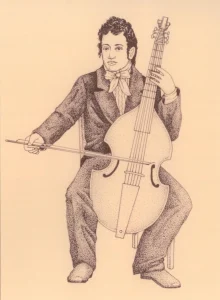
…While the question of our settlement was pending, we invited and received the royal family on board the brig to dine. … All assembled on the quarter-deck of the Thaddeus; and the mission family with the aid of a bass-viol, played by George P Kaumuali‘i, and of the voices of the captain and officers, sang hymns of praise.
“Apparently pleased with this exercise, and with their interview with the strangers, our royal visitors gave us a friendly parting aloha, and returned with favorable impressions of the singular group of newcomers, who were seeking among them an abode in their isolated territories.”(Spoehr)(Photo credit-Racoma)
“In these sacred songs, George P Kaumuali’i assisted both by his voice and the bass-viol. They appeared attractive to native ears, as well as to the naturalized foreigner, who had seen better days.” (Bingham)
“April 23 (1820) Sabbath…Our singing, aided by the bass viol, on which G. P. Tamoree (Prince George Kaumuali‘i) played, was pleasing to the natives, and will probably have a salutary influence in winning them to approve and to engage in Christian worship.” (Journal of the Mission, Missionary Herald, May, 1821)
for more imformation on Humehume and knowledgeable articles on Mission activities, see Peter Youngʻs many posts: Humehume-https://imagesofoldhawaii.com/bass-viol/Bass Viol/ Peter Young
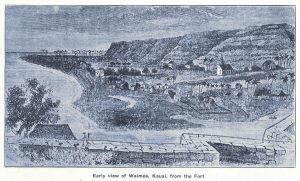
In late July, Ruggles and Whitney with their wives returned to Kauai to establish the mission. George took great care of the Whitneys as his missionary family. Kaumualiʻi provided a house, furnishings and every need as they settled. Initially, they had meals provided by Prince George and his servants in his own eating house.
But the joyous homecoming was short-lived, as George was disappointed with the overall situtation of his father as only a tributary chief, anwerable to Liholiho in all important matters. Kaumualiʻi noticed that his decisions were often rash, and drinking alcohol made things worse;it is said that many were aware of his rascality.
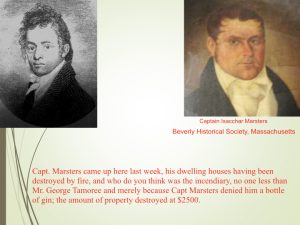
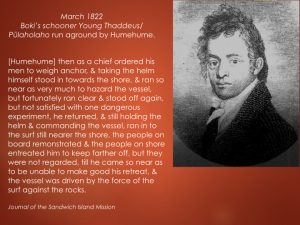
His final notable act as Prince George Tameoree, was on Aug 8, 1824, a few months after the passing of his father, when he led a rebellion against the Kamehameha line now in charge at the fort. 1000 troops were sent in defense from Oʻahu. There we casualties on both sides at the fort, but many more who fled were hunted and killed…known on Kauaʻi as Aipuaʻa. Humehume was found and delivered to Kalanimoku on O’ahu, where he was held in close protective custody until his death from influenza in May, 1826. He was buried in a common unmarked grave.

*Click to read the article


‘AHAHUI KAUMUALI‘I
P.O. Box 509 Waimea, Kauaʻi, HI 96796
kumukeao@gmail.com